
LPL Logo

When the Storm Passes
A Warning the World Had Never Issued Before

On the morning of 1 June 2026, the Japan Meteorological Agency transmitted two alerts that no authority in Japan had ever sent. As Tropical Storm Jangmi — taif? No. 6 in the domestic classification — tracked north-northwest from the Philippine Sea across Okinawa and the Amami Islands toward Kyushu and ultimately toward the Kant? region, the JMA issued Japan's first-ever Level 3 Heavy Rain Warning in Nakijin Village, Okinawa. Hours later it followed with the country's first-ever Level 4 Flood Danger Warning. By the time the storm had cleared Ky?sh? on 3 June, at least 16 people had been injured across Okinawa and Kagoshima prefectures, nearly all knocked over by sustained winds, and close to 48,000 households had lost power.

What was unprecedented was the system that described it. On 28 May 2026, just four days before Jangmi made landfall, Japan had deployed a wholly revised national disaster information architecture: a tiered, differentiated warning structure replacing the older JMA hazard scale with a five-level alert system in which each level corresponds to a specific recommended public action. Level 1 activates early preparation. Level 2 signals high-risk groups to evacuate. Level 3 orders evacuation for the elderly and vulnerable. Level 4 triggers universal evacuation orders for the affected area. Level 5 is catastrophic: a designation issued in retrospect after the disaster has already arrived, intended to document rather than prevent. Jangmi reached Levels 3 and 4. Japan's infrastructure was ready.

What the Data Actually Shows

The dominant framing in disaster mental health has historically been diagnostic: measuring PTSD prevalence after a specific event, in a specific population, at a specific interval. Those measurements vary so substantially that a single figure can be misleading. Across earthquake studies, PTSD prevalence estimates range from 11.7 to 82.6 percent depending on timing, instrument, sampling strategy, and exposure severity. Any figure cited in isolation tells us more about the study design than about the disaster.

The most relevant comparison comes from a meta-analysis by Wang and colleagues published in 2019 in Disaster Medicine and Public Health Preparedness, drawing on 39 studies and 43,123 survivors with 9,373 confirmed PTSD cases. The pooled PTSD prevalence for typhoon and hurricane survivors was 17.81 percent. Among flood survivors, a comparable figure of 15.74 percent is reported in the literature; among earthquake survivors, 23.66 percent. The authors were direct about the mechanism: earthquakes happen suddenly and without warning, whereas the direction and intensity of a hurricane or typhoon can be predicted. A clear dose-response by storm category was also documented, with Category-5 storms producing meaningfully higher prevalence than Category-4 and lower.

PTSD Prevalence by Disaster Type — Meta-analytic Estimates
17.81% Typhoon & Hurricane survivors
Wang et al., 2019 — 39 studies, N=43,123
15.74% Flood survivors
Comparative literature
23.66% Earthquake survivors
Comparative literature

The lower rate for typhoons vs. earthquakes reflects the advance-warning window: prediction time is coping time.

A 2025 meta-analysis in Clinical Psychology Review, covering 47 samples and 25,085 survivors with hurricanes and typhoons comprising 53 percent of disaster types, confirmed that severity of exposure (r = .26), income (r = ?.26), and prior psychopathology (r = .26) were the strongest acute predictors of PTSD symptoms. What both meta-analyses conspicuously leave unexamined is the personality variable: who, among people with equivalent exposure, income, and prior history, recovers well? The clinical literature consistently finds variance that those predictors do not account for. That residual variance is substantially dispositional.

A study of 1,876 students following Typhoon Hato in Macao in 2017 found that frequent exposure to distressing media imagery was associated with PTSD symptoms entirely independent of direct personal exposure to the storm. Jangmi arrived in the social-media era, and its visual record was global within hours. Psychological impact from a typhoon is no longer bounded by the storm's physical footprint.

Typhoons carry a pooled PTSD prevalence of 17.81%, against 23.66% for earthquakes. The advance-warning window is coping time, and what determines how well that time is used is who you already are.

Trait Emotional Intelligence: What It Is and What It Predicts

Trait emotional intelligence (trait EI) is not the ability to name your feelings or to identify expressions in photographed faces. Those are ability constructs, measured by performance tests that have, with notable consistency, failed to predict real-world outcomes in high-pressure domains. Trait EI is a different kind of variable: a constellation of stable, self-assessed personality dispositions that describe how a person characteristically perceives, processes, manages, and uses emotional information across the situations that constitute their daily life.

Measured by the TEIQue, developed by Professor K.V. Petrides at University College London and the only instrument validated against the full domain-sampling definition of trait EI, the construct organises 15 facets into four factors alongside two auxiliary facets, Adaptability and Self-Motivation.

Well-Being
Happiness · Optimism · Self-Esteem
Self-Control
Emotion Regulation · Impulse Control · Stress Management
Emotionality
Empathy · Emotion Perception · Emotion Expression · Relationships
Sociability
Emotion Management · Assertiveness · Social Awareness

A 2010 meta-analysis by Martins, Ramalho and Morin, covering 105 effect sizes, established the overall association between trait EI and mental health at r ? .36. The biological substrate of this protection was mapped in a 2020 synthesis by Sarrionandia and Mikolajczak covering 106 studies and 45,262 participants, which identified social support, sleep quality, and HPA-axis cortisol regulation as the three primary pathways through which trait EI exerts its protective effect. The HPA axis governs the body's stress response system. Its chronic dysregulation is a documented biological marker of PTSD. The pathway from trait EI to psychological resilience runs, in part, through measurable neurophysiology.

For the typhoon context specifically, the most pertinent literature concerns coping self-efficacy: the belief in one's own capacity to manage post-trauma demands. In a landmark 2004 paper in Behaviour Research and Therapy, Benight and Bandura described this as a pivotal factor in trauma recovery. Following Hurricane Opal, Benight and colleagues found it to be the single strongest predictor of low trauma-related distress, outperforming lost resources, social support, and optimism.

The trait EI facets of Stress Management, Optimism, and Self-Motivation describe exactly the dispositional substrate that coping self-efficacy requires, operating before the environment provides any objective basis for confidence.

A 2026 RCT in Scientific Reports confirmed that EI training improves stress regulation and performance under acute pressure in high-stakes settings, with the authors extending implications to populations including paramedics, firefighters, and law enforcement — groups in which SAMHSA estimates a 30 percent prevalence of behavioural health conditions compared with 20 percent in the general population.

The Suppression Question: Why Emotional Competence Is Not Universal

There is a foundational assumption embedded in most of the Western emotion regulation literature, and it needs to be examined carefully before applying EI frameworks across cultures. The assumption is that expressive suppression — the deliberate inhibition of emotional expression — is maladaptive: that it elevates physiological arousal, impairs interpersonal communication, reduces wellbeing, and, in the disaster context, prevents the processing needed for recovery. This view is backed by substantial research conducted primarily on European and American samples.

It does not generalise.

A systematic review synthesising cross-cultural emotion regulation research found that collectivist cultures, including Japan, China, and Nigeria, systematically favour expressive suppression as a primary emotion regulation strategy, while individualist cultures, including the United Kingdom, the United States, and Germany, favour cognitive reappraisal and open expression. What matters is the next finding: the negative association between expressive suppression and trait EI appears only in European-American samples. In East Asian samples, that association is absent (Nozaki, 2018). Suppression is not a maladaptive regulatory failure in those contexts. It is a culturally sanctioned, socially functional strategy that carries different psychological costs and benefits depending on the norms of the society in which it is deployed.

Hirano and colleagues, writing in the Asian Journal of Social Psychology in 2024, found that Japanese participants who leaned toward suppression and avoidant coping reported lower happiness and greater loneliness than American participants who favoured reappraisal. This is an important finding, but it requires careful interpretation. The outcome measures — happiness and loneliness as Western psychological constructs — may themselves carry individualist assumptions. A Japanese person who endorses the suppression items and scores lower on happiness-as-measured-by-a-Western-scale may simultaneously be fulfilling deeply valued social obligations that a Western instrument does not capture. The question of whether they are suffering is not straightforwardly answered by their scale score.

This matters directly for how the TEIQue's Emotion Expression and Emotion Regulation facets are interpreted across cultures. The TEIQue's own description of the Emotion Regulation facet makes a point that is easily overlooked: emotion regulation is very different from suppressing or ignoring your emotions. The instrument is measuring perceived control over internal states, not the display or concealment of those states to others. That distinction is meaningful. A Japanese disaster survivor who maintains composure in public while retaining the internal capacity to process and regulate their distress is not demonstrating low trait EI. They are demonstrating a culturally specific version of high trait EI. A Japanese survivor who maintains the same public composure but is privately overwhelmed and unable to process their experience — producing the delayed help-seeking that Dr. Hiroshi Kato of the Hyogo Institute for Traumatic Stress has documented — is demonstrating something different: a trait profile that looks similar from the outside but carries elevated risk from within.

Suppression is not inherently maladaptive. It is maladaptive in certain Western cultural contexts. The challenge for cross-cultural EI assessment is distinguishing the person who is culturally regulating from the person who is privately overwhelmed, when both look identical from the outside.

This is the most precise psychometric challenge in the entire disaster-EI literature. The TEIQue facet structure, with its distinction between Emotion Regulation (internal) and Emotion Expression (external), is positioned to map exactly this polarity. What no study has yet done is test it empirically in a cross-cultural disaster context. The Japan-versus-West comparison remains, for now, a precisely specified gap rather than a resolved question.

From Individual Regulation to Community Recovery: The TSIQue

Disaster recovery is not fundamentally an individual psychological process. It is an interpersonal coordination problem. Whether a community rebuilds, and how quickly, depends less on the aggregate individual trait EI of its members than on the quality of the relationship networks, trust capital, and cooperative capacity those members bring to the recovery process. This is not a theoretical claim. It is the empirical finding of two decades of comparative disaster recovery research.

Daniel Aldrich's 2012 analysis of recovery trajectories across the 1923 Tokyo earthquake, the 1995 Kobe earthquake, the 2004 Indian Ocean tsunami, and Hurricane Katrina established that depth of community social capital was the single strongest predictor of recovery pace, outperforming disaster magnitude, external aid volume, and physical infrastructure. A 2022 study by Aldrich and colleagues following over 1,000 survivors post-T?hoku found that residents who participated in an elder-led community centre reported significantly higher family and neighbourhood recovery than non-participants. Connection determined trajectory.

The psychometric instrument positioned to capture this dimension is the Trait Social Intelligence Questionnaire (TSIQue), developed by Petrides, Mason, and Sevdalis. The TSIQue maps 17 variables across three factors: Social Acting (how effectively a person performs in social interactions), Social Cognizing (how accurately they read social situations and others' intentions), and Social Relating (how successfully they build and sustain relationships). These factors describe, at the individual level, exactly the capacities that Aldrich's social capital framework identifies at the community level. A community with high aggregate Social Relating has, in the TSIQue sense, the interpersonal infrastructure that the literature identifies as the most reliable driver of recovery.

No published study has applied the TSIQue to disaster coordination or community solidarity. This is a significant gap, and it is not one that will fill itself without instruments specifically designed to measure the interpersonal dimension of personality.

Closing Reflection

When taif? No. 6 passed over Okinawa in the early hours of 1 June 2026, Japan's newly deployed five-level warning system transmitted a message that no authority in its history had transmitted before. The storm was real. The warning was calibrated. The institutional response functioned. By the comparative standards of global disaster management, Japan performed well.

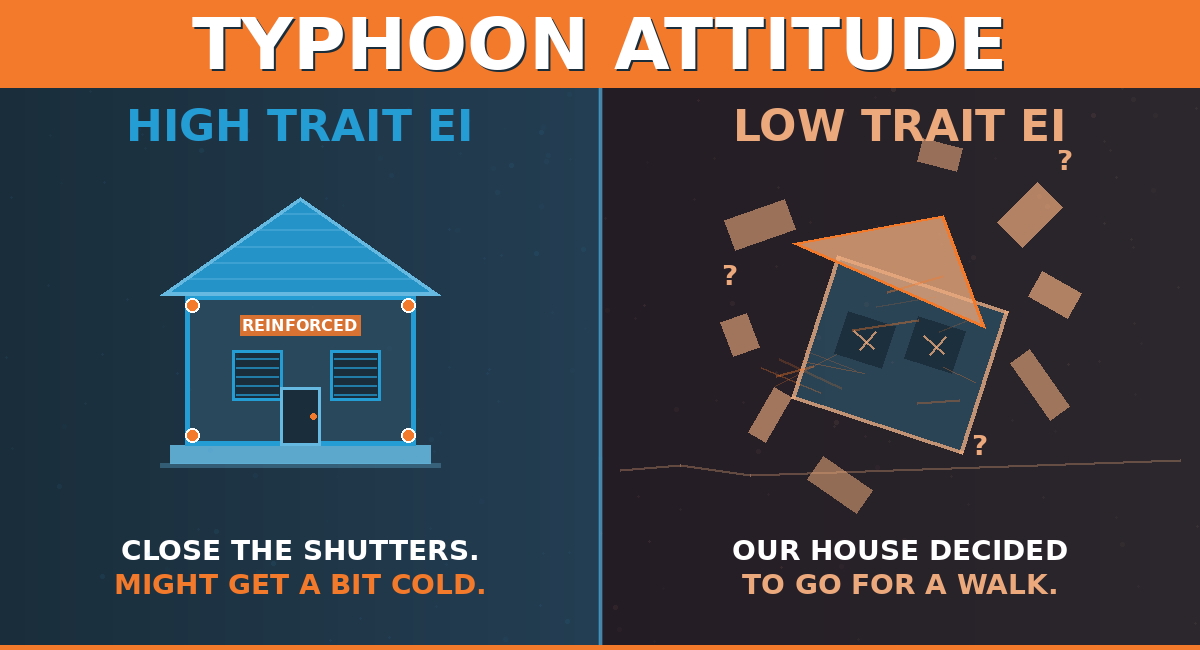
But institutional performance and psychological outcome are not the same thing. The survivors who secured their shutters in Nakijin Village did not all go through that experience with the same inner resources, or emerge from it on the same trajectory. Some, over the months that follow, will grow. Some will not. Some will appear to recover and then deteriorate. And some, applying gaman (Japanese stoic endurance) in its most socially compliant and most psychologically costly form, will suppress their distress to the point at which it becomes invisible to every measure except the ones designed to find it.

Those measures exist. They have been independently validated. They have been applied in dozens of countries and professional contexts. The one thing they have not yet been applied to, with the cross-cultural rigour that the question demands, is the psychology of disaster itself. That application does not require new instruments. It requires the decision to take the measurement seriously.

Key References
  • Aldrich, D.P. (2012). Building Resilience: Social Capital in Post-Disaster Recovery. University of Chicago Press.
  • Aldrich, D.P. et al. (2022). Social capital and post-disaster family and neighbourhood recovery. Scientific Reports, 12.
  • Benight, C.C. & Bandura, A. (2004). Social cognitive theory of posttraumatic recovery. Behaviour Research and Therapy, 42(10): 1129–1148.
  • Benight, C.C., Ironson, G. & Durham, R.L. (1999). Coping self-efficacy following Hurricane Opal. Journal of Traumatic Stress, 12(2).
  • Gauthier, G.M., Pandey, S., Sanchez, V., Stromberg, S.E. & Zoellner, L.A. (2025). Posttraumatic stress disorder and climate change: A meta-analysis of prospective, acute predictors of PTSD following extreme weather events. Clinical Psychology Review, 122: 102662.
  • Hall, B.J., Xiong, Y., Yip, P.S.Y., Lao, C., Shi, W., Sou, E.K.L., Chang, K., Wang, L. & Lam, A.I.F. (2019). The association between disaster exposure and media use on post-traumatic stress disorder following Typhoon Hato in Macao, China. European Journal of Psychotraumatology, 10: 1558709.
  • Hirano, H. et al. (2024). Exploring emotion regulation and coping across cultures: Implications for happiness and loneliness. Asian Journal of Social Psychology.
  • Kato, H. (2012). Reported in Psychiatric News/PLOS One. Hyogo Institute for Traumatic Stress, Kobe.
  • King, J.B., Li, Y., Gillespie, N.A. & Ashkanasy, N.M. (2026). Emotional intelligence training improves stress regulation and performance in high-stress occupations. Scientific Reports, 16(1): 6673.
  • Martins, A., Ramalho, N. & Morin, E. (2010). A comprehensive meta-analysis of the relationship between emotional intelligence and health. Personality and Individual Differences, 49(6): 554–564.
  • Nozaki, Y. (2018). Cross-cultural comparison of the association between trait emotional intelligence and emotion regulation in European-American and Japanese populations. Personality and Individual Differences, 130: 150–155.
  • Petrides, K.V. (2010). Trait emotional intelligence theory. Social Behavior and Personality, 38(5): 697–710.
  • Petrides, K.V. (2011). Psychometric theory of trait EI. Scandinavian Journal of Psychology, 52(2): 161–167.
  • Petrides, K.V. (2019). Psychobionomy. Personality and Individual Differences, 147: 135–143.
  • Petrides, K.V., Mason, M. & Sevdalis, N. (2011). Trait social intelligence. Personality and Individual Differences.
  • SAMHSA (2018). First Responders: Behavioral Health Concerns, Emergency Response, and Trauma. Supplemental Research Bulletin.
  • Sarrionandia, A. & Mikolajczak, M. (2020). A meta-analysis of the possible behavioural and biological variables linking trait emotional intelligence to health. Health Psychology Review, 14(2): 220–244.
  • Sarrionandia, A., Ramos-Díaz, E. & Fernández-Lasarte, O. (2018). EI as predictor of resilience and stress. Frontiers in Psychology, 9: 2653.
  • Turnbull, A. et al. (2025). Systematic review: cross-cultural emotion regulation strategies.
  • Wang, Y. et al. (2019). Prevalence of PTSD among typhoon and hurricane survivors. Disaster Medicine and Public Health Preparedness. 39 studies, N=43,123.


Shopping Cart

Your cart is empty